The Smoke Temperature Analysis and Smoke Gas Component Distribution Using the Staircase Pressurisation System
Keywords:
Fire safety, Staircase pressurisation system, CFD, Smoke control System, Differential pressureAbstract
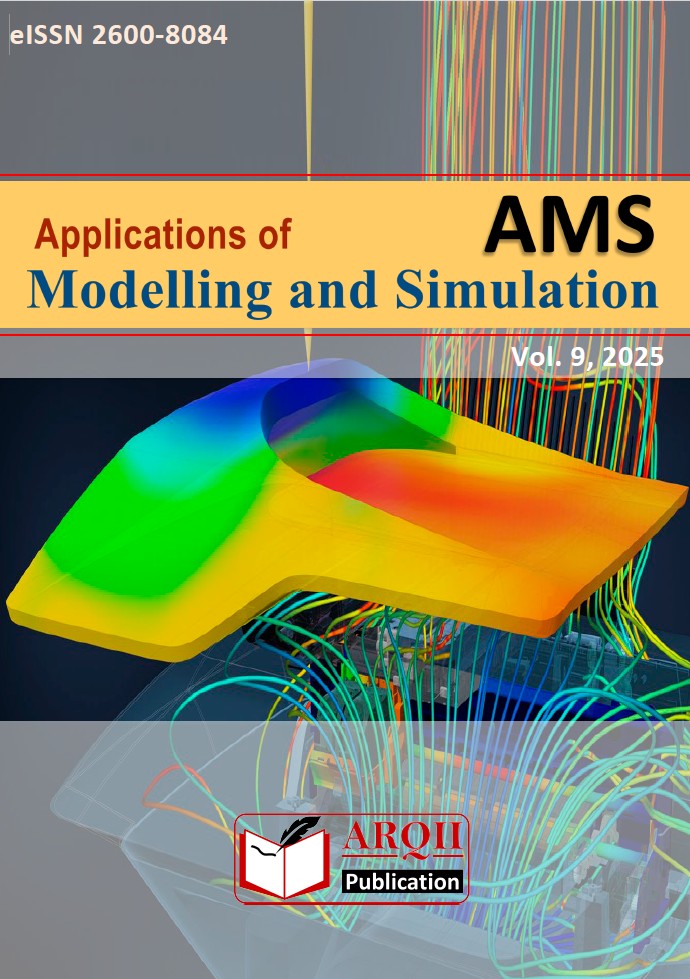
This study investigates the impact of staircase pressurisation systems on smoke temperature and the distribution of smoke gas components in a 3-storey building using Computational Fluid Dynamics (CFD) simulations. Staircase pressurisation systems are designed to create a differential pressure that prevents smoke infiltration, ensuring staircases remain safe evacuation routes. This research uses CFD to predict the effectiveness of pressurised staircase systems on smoke gas product carbon dioxide (CO2) infiltration into the staircase space at a differential pressure of 50 Pa, as per MS 1472, in comparison to a non-pressurised staircase system. The inlet of the smoke mass flow rate and temperature are 6.544 kg/s and 535K, respectively. The simulations reveal that without a pressurisation system, smoke can occupy the 3-storey building in less than 5 minutes. Conversely, the pressurisation system prevents smoke from propagating and infiltrating the stairwell. Moreover, the staircase pressurisation system reduces the maximum air temperature in the staircase space from 535K to approximately 307K. This study analyses both smoke temperature and gas component distribution to evaluate the effectiveness of staircase pressurisation systems.References
[1] W. Wang, Z. Zhu, Z. Jiao, H. Mi and Q. Wang, Characteristics of fire and smoke in the natural gas cabin of urban underground utility tunnels based on CFD simulations, Tunnelling and Underground Space Technology, 109, 2021, 103748.
[2] M. Seike, N. Kawabata and M. Hasegawa, Quantitative assessment method for road tunnel fire safety: Development of an evacuation simulation method using CFD-derived smoke behavior, Safety Science, 94, 2017, 116-127.
[3] W. Z. Black, Smoke movement in elevator shafts during a high-rise structural fire, Fire Safety Journal, 44(2), 2009, 168-182.
[4] D. Zhao, J. Jiang, R. Zhou, Y. Tong, F. Wu and L. Shi, Numerical study on the optimisation of smoke ventilation mode for interchange subway station fire, International Journal of Ventilation, 15, 2016, 79-93.
[5] J. Zhou, J. Mao, Y. Huang and Z. S. Xing, Studies on smoke temperature distribution in a building corridor, Journal of Asian Architecture and Building Engineering, 16(2), 2017, 341-348.
[6] B. Merci and M. Shipp, Smoke and heat control for fires in large car parks: Lessons learnt from research?, Fire Safety Journal, 57, 2013, 3-10.
[7] H. B. A. Bakar, Guide to Fire Protection, Kuala Lumpur, Malaysia: The Institution of Fire Engineers (UK) Malaysia Branch (IFEM), 2006.
[8] K. Butcher, Relationships for Smoke Control Calculations, London, UK: The Chartered Institution of Building Services (CIBSE), 1995.
[9] M. Maarof, Effectiveness of fire protection system in Malaysia government, Fire and Rescue Department of Malaysia, Kuala Lumpur, 2020.
[10] H. Park, B. Meacham and N. Dembsey, Conceptual model development for holistic building fire safety, Fire Technology, 51, 2013, 173-193.
[11] C. Bellido, A. Quiroz, A. Panizo and J. L. Torero, Performance assessment of pressurized stairs in high-rise buildings, Fire Technology, 45, 2009, 189-200.
[12] British Standards Institution, Framework for Application of Fire Safety Engineering Principles to the Design of Buildings, Code of Practice BS 7974: Part 2, London, UK: BSI, 2001.
[13] M. J. Lee, S. Park and N. I. Kim, An experimental study for the flow rates of automatic pressure smoke dampers and their applications, Journal of Mechanical Science and Technology, 27, 2013, 1313-1320.
[14] B. Hepguzel Acikyol, B. Balik and G. Kilic, An experimental investigation of the effect of fire protection lobby on stair pressurisation system in a high-rise building, Fire Technology, 53, 2017, 135-151.
[15] W. You, J. Nam and H. Ryou, An analysis of the opening and closing condition with various fire door size in the pressurized room, Fire Science and Engineering, 25(2), 2010, 132-137.
[16] W. You, G. Ko, S. Sakong, J. Nam and H. Ryou, An analysis on the major parameter and the relations of pressure difference effect of leakage area in the smoke-control zone, Fire Science and Engineering, 27(1), 2013, 20-25.
[17] M. A. Ismail and J. Wang, Effect of nozzle rotation angles and sizes on thermal characteristic of swirl anti-icing, Journal of Mechanical Science and Technology, 32, 2018, 4485-4493.
[18] W. -S. Kim, P. T. Thang and B. -K. Kim, CFD simulations of plate-fin cross-counter flow compact heat exchanger, Journal of Mechanical Science and Technology, 38, 2024, 969-978.
[19] S. A. Tan, K. H. Yu and M. Z. Abdullah, Heat transfer analysis on wafer annealing process in semiconductor multi-wafer furnace using CFD simulation, Journal of Mechanical Science and Technology, 36, 2022, 3143-3151.
[20] H. Jo, K. Kang, J. Park, C. Ryu, H. Ahn and Y. Go, Detailed assessment of mesh sensitivity for CFD simulation of coal combustion in a tangential-firing boiler, Journal of Mechanical Science and Technology, 34, 2020, 917-930.
[21] S. Hwang, R. Choi, S. Kim, M. Song and T. Kim, Numerical analysis of LiFePo4 battery thermal management system using cold plate, Journal of Mechanical Science and Technology, 37, 2023, 3163-3171.
[22] S. Lu, Y. H. Wang, R. F. Zhang and H. P. Zhang, Numerical study on impulse ventilation for smoke control in an underground car park, Procedia Engineering, 11, 2011, 369-378.
[23] M. Wesseling, M. Schmidt and D. Muller, Numerical robustness analysis of natural and mechanical smoke extraction systems for buildings, International Journal of Ventilation, 18(2), 2018, 79-95.
[24] H. Lee, S. Park and J. Kim, CFD simulations for staircase pressurisation systems in high-rise buildings, Fire Safety Journal, 42, 2016, 567-578.
[25] Y. Park, J. Na, K. H. Kun Hyuk Sung and H. S. Sun Ryou, Numerical study on the effect of elevator movement on pressure difference between vestibule and living room in high-rise buildings, Building Simulation, 12(2), 2018, 1-9.
[26] K. H. Sung, H. J. Shin, D. Dabin Baek and H. S. Ryou, The effect of damper leakage and fire size on the performance of smoke control system in high-rise building, Journal of Mechanical Science and Technology, 31, 2017, 4029-4034.
[27] Smoke Control Association, CFD Modelling for Car Park Ventilation Systems - A Guide for Designers and Regulators. London, UK: Smoke Control Association, 2007.
[28] F. Morgan and M. K. Morgan, Comparison of design equations for mass flow rates in fire smoke plumes, Journal of Fluid Dynamics in Fire, 15(5), 2016, 233-250.
[29] National Fire Protection Association (NFPA), in SFPE Handbook of Fire Protection Engineering, 5th ed., Quincy, MA: 2016.
[30] National Fire Protection Association (NFPA), in NFPA 92: Standard for Smoke Control Systems, Quincy, MA: NFPA, 2021.
[31] Department of Standards Malaysia, MS 1472:2007 – Code of Practice for Fire Precautions in the Design of Buildings — Part 8: Smoke Control in Protected Escape Routes Using Pressurization. Cyberjaya, Malaysia: Department of Standards Malaysia, 2007.
Downloads
Published
How to Cite
Issue
Section
License
Copyright (c) 2025 Muhammad Asyraf Rusli, Ahmad Syazwan Ahmad Kamal, Mohd Redzuan Tarmizi, Muhammad Firdaus Khan Anwat Khan, Hasrul Kamal, Mohd Azmi Ismail

This work is licensed under a Creative Commons Attribution 4.0 International License.
Authors who publish with this journal agree to the following terms:Authors hold and retain copyright, and grant the journal right of first publication, with the work after publication simultaneously licensed under a Creative Commons Attribution 4.0 License CC BY that permits any use, reproduction and distribution of the work and article without further permission provided that the original work is properly cited.
Authors are permitted and encouraged to post their work online in institutional repositories, website and other social media before and after publication, as it can lead to productive exchanges, as well as earlier and greater citation of published work.